Tires to fit a Series Land Rover are not cheap items so it is good economics to take care of them. This article attempts to outline what problems to look for and how to correct the causes of them. Apart from tire pressure issues, which affects all tires, it focusses mainly upon the front wheels. Part 2 (February 2016) will look at tire problems that could affect both front and rear tires.
Correct inflation
Correct tire inflation not only puts the full amount of tread onto the road surface but can also reduce the chance of having steering or braking problems.
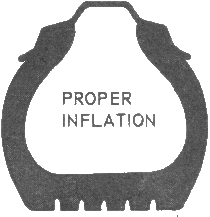
Ride comfort can also be affected, though " comfort" is generally associated with Series Land Rovers!
Under-inflation
If a tire is under-inflated, the walls will bulge out and the center of the tire
will be lifted off the road surface, causing less wear to take place on the central tread. Also, if the walls bulge outwards then they will be bent more often as the wheel rotates and to a larger extent; this causes heat to develop in the tire wall and could cause the tire to burst.
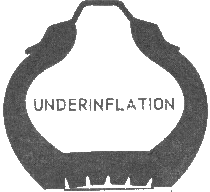
Under-inflation can also cause the cracking of the tread pattern over time; this is due to the stretching and compressing of the tire tread horizontally, especially as the wheels are steered.
On the road, under-inflation can be a cause of a) the Land Rover pulling to one side b) the steering being extra heavy (even for a Series Land Rover) or c) the wheels to shimmy side-to-side after hitting a pot-hole.
If the tire is under-inflated in an offroad environment, then a sudden impact with a solid object (e.g. a rock) will casue the tire to be violently squeezed between the rock and the rim. Such impacts can result in internal damage to the tire and to cause weak spots which can subsequently cause failure.
Over-inflation
Over-inflation results in the tire running on its central tread only, causing just this part of the tread to wear more quickly than the rest. There is less area contact with the road surface and so increased risk of skidding and aquaplaning.
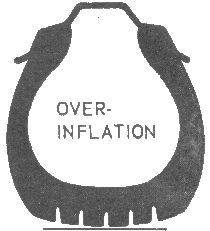
If the tire is over-inflated in an offroad environment, then impacts with objects are not cushioned to the same extent as if the tire was correctly inflated. Hard impacts with over-inflated tires causes internal tire damage.
Toe-in
The toe-in setting for a Series Land Rover is 1/8th to 3/16th inch (1.2mm to 2.4mm). If this is not correct then tires will be dragged across the road, causing the tread to develop feathered edges (noticed by moving your fingers across the tread pattern and feeling it smooth in one direction and rough in the opposite direction - rather like saw teeth). For a wheel with a 1/8th inch of incorrect toe-in, the tire can be dragged over 100feet across the road for every mile it travels.
Mechanical
problems
Wheel alignment, steering geometry and swivel pins all affect tire wear, as well as improperly adjusted or unbalanced brakes, unbalanced wheels and worn wheel bearings. If several of these problems exist simultaneously, then the wear pattern can be complex. Look for cupped areas or bald spots in the tread.
Tread wear patterns
Close inspection of the tread pattern on a tire can suggest what the cause of the problem may be.
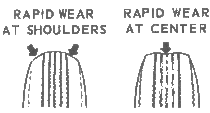
tire wear patterns for under-inflated (left) and over-inflated (rght)
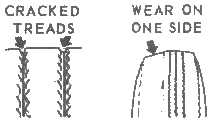
tire wear patterns for under-inflation/speeding (left) and incorrect alignment (right)
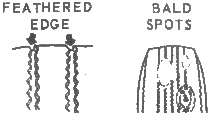
tire wear patterns for
incorrect toe-in (left) and multiple causes (right)

************************
(To see previous homepages visit the Homepage Archives link)
**************************


 or
or 
 Enter
Enter

 Series
quiz
Series
quiz  Back
to top
Back
to top