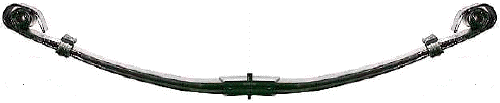
December 2007's homepage mentioned the advantages of the reduced weight and increased flexibility that parabolic springs can bring to a Series Land Rover. They are however, a specialist spring and not all applications gain significantly from their use. Their ability to support a Series Land Rover on less leaves than conventional springs carries with it the reduced ability to be overloaded without serious damage. Not that any suspension system should be overloaded, but the Series Land Rover was developed with the knowledge that owners did not always respect the Rover company's suggested limitations.
Both for road use and for use offroad, where heavy loads are not to be carried, then parabolic springs have definite advantages. Extra care would be needed though, if driving a fully loaded Series Land Rover offroad. They are not as robust as standard leaf springs. Having said that, if driven slowly and carefully, the parabolic springs provide the extra articulation needed for rock crawling.
Some spring manufacturers can supply 4 leaf parabolics for more heavy duty use. These 4 leafers are usually recommended for Series LWB Station wagons, particularly if they have camper conversions e.g Dormobile. They would also be recommended for any vehicle that was to take part on an overland expedition, where extra loading is inevitable.
The flexibility of parabolics tends to change the handling characteristics of a Series Land Rover such that the vehicle leans more on corners. This can be more problematic if the vehicle has a loaded roof rack and might lead to a need to reduce speed in certain circumstances.
Another situation where parabolics can possibly lose out to standard springs is
on corrugated dirt roads: the rapid flexing of the springs tends to cause the vehicle to 'float' more than standard leafers and the steering wanders about more. Having said that, the much smoother ride that parabolics provide on corrugations at reasonable speeds has to be experienced to be believed.
Generally speaking, if driven offroad with care, not seriously overloaded and not against the clock for points, then parabolic springs should be fine.

************************
(To see previous homepages visit the Homepage Archives link)
**************************


 sections
 Enter
Enter

 Series
quiz
Series
quiz  Back
to top
Back
to top