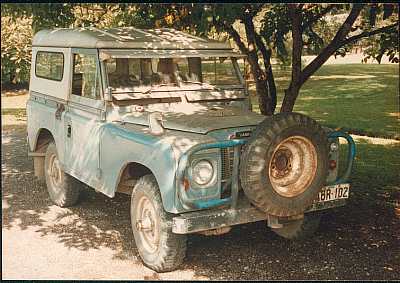
Series Land Rover
(UK/Europe)
|
|
![]() |
|
Land Rover Series 3 Latest Website Updates More Travel insurance (14/6/07) Updated Tech Section (11/6/07) Fixed date problem on forums (10/6/07) Dakar Rally DVD's (1/6/07) Corrected Series quizzes (27/5/07) Cartoon e-Greetings cards (26/5/07) Scottish Holiday Cottages (17/5/07) More cheap tyres (12/5/07) Series1 model (12/5/07) Updated 4x4 activities section (3/4/07) More Land Rover books (6/3/07) Last Updated 25/6/07 |
A Brief History of the Land Rover Series IIIWhen the Series 3 Land Rover replaced its Series 2 counterpart in Oct 1971 little was changed with respect to chassis, wheelbase dimensions, body styles and suspension. The greatest change was that the Series 3 gearbox had synchromesh on all gears instead of just 3rd and 4th and 1st and reverse ratios were reduced: A diaphragm clutch was introduced: Dynamos were exchanged for alternators: The radiator grill and dashboard were re-designed. There was also a new steering wheel and improved heater. Servo assisted brakes were standard on the Series 3 109 station wagon and an optional extra on other Land Rover Series 3's. Stronger halfshafts were fitted to the 109 models.
From the Spring of 1974 the Fairy overdrive (offering about 3mpg reduced fuel consumption on long runs) was available as an optional extra, but it could also be fitted retrospectively to any Series II or IIA Land Rover. The one millionth Land Rover was a Series 3 and was manufactured in June 1976. The Series 3 V8 station wagon (known as the Stage 1) was introduced for overseas markets in 1979 and for the UK market one year later. The introduction of the larger V8 engine and transmission meant the loss of the front body recess; a major visual change to the Series Land Rover. In 1980 the petrol and diesel 4 cylinder engines from Series 3 Land Rovers were upgraded from a 3 to a 5 bearing crankshaft. In the spring of 1982 the Land Rover "County" option of styling and accessories was introduced, including tinted glass; Masai Red or Russet Brown paint with striping; grey or black headlamp bezels; twin driving lamps; sound insulation; spare wheel cover; lifting and towing rings; reversing light; ashtray; indicator repeaters and radial tyres on 5.50 x 16 rims. Despite the 110 Land Rover going into production in 1983 with the much more comfortable coil spring suspension, the Series 3 still continued in production until the end of 1985. The very last Land Rover Series 3 to come off the production line was a 109 station wagon which is now preserved in the UK Heritage Motor Museum.
****************************************************************** Visit the current Series Land Rover 123 homepage |
Try Series II quiz only Try Series III quiz only 4x4 offroad quiz Choose how many multiple choice questions you attempt. Rank your score with other participants. Land Rover (or spare parts) for sale/wanted? Problem you can't solve? Check the Tech Articles Or visit our forums Land Rover Series i forum Land Rover Series ii forum Land Rover Series iii forum Can you help? Check current problems: Fascinating facts (No.65) The first Land Rover prototype was seen at the Royal Show at York, England. |
Copyright 2002-07 Series123.com. All rights reserved