Series Land Rover (U.S.A./Canada)
Serving the Series 1, Series 2, Series 3 and other Land Rover communities worldwide.


search
USA owners of non-series
Land Rovers and other
4x4's should visit our
sister site also:

ukoffroad.com
May 2009 Homepage
(U.S.A./Canada)

Visit our Australia Australia / NZ   or UK sections


Select yourSeries
Land Rover Series 1 Enter
Land Rover Series 1

Land Rover Series 3Enter
Land Rover Series 3


Problem you can't solve?

Check the Tech Articles
Or visit our forums

Land Rover Series I
Land Rover Series 1
forum

Land Rover Series II
Land Rover Series 2
forum

Land Rover Series III
Land Rover Series 3
forum


Latest Website Updates

4x4 Driving Experiences in USA. and CANADA.

More camping gear


More Garage/Workshop tools

Live feed from Ebay for LR Series spares


More Land Rover Toys


battery chargers


Vehicle covers

Last Updated 5/12/09

Browse a range of 4x4 and other adventure experiences
in the
USA.
 

Series Land Rover Floor Repair

The body of a Series Land Rover is made from an aluminium alloy, which is very resistant to corrosion once it has built up a thin oxidised protective layer. However, we often see extensive corrosion of the bodywork at points where the aluminium is in direct contact with the steel of the chassis. One such area where this occurs in both SWB and LWB Series Land Rovers is at the rear chassis cross member supports for the body. However, the focus of this homepage is on the two supports which hold up the central floor section of the Series Land Rover stationwagons. This section is easily observed just infront of the rear wheels.

The corrosion can also often be found around the holes in the horizontal flange that supports the floor panel; possibly due to interaction between the steel of the floor fixing screws and the aluminium of the flange.
Both of these floor problems can be sorted by using aluminium angle.
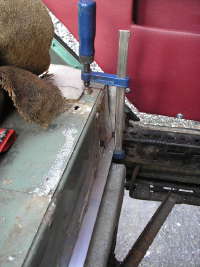
First, the existing floor support flange must be sawn away and the two horizontal bolts through the chassis support brackets removed. The aluminium angle can then be slid under the vertical floor section from the front and held in position with clamps (photo left).

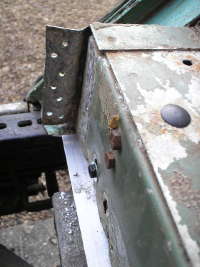
Now the reinforcing floor end corners should be carefully bent outwards after drilling through the spot welds that hold them (photo right). The vertcial section of the floor section can now be drilled through to the aluminium angle at about 7-8cm spacing and the two riveted together with pop rivets. Finally, the end corners previously bent outwards can be carefully re-positioned and pop riveted to the vertical floor section and the aluminium angle.


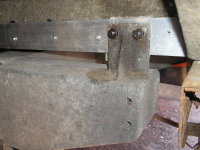
The above photo shows the completed repair with the aluminium angle iron fixed in place.

********************************************

To see previous homepages visit the
Series Land Rover Archives

********************************************

Google

www series123.com


Land Rover QuizSeries quiz
Try Series i quiz only

Try Series ii quiz only


Try Series iii quiz only

4x4 offroad quiz
Choose how many multiple choice questions you attempt. Rank your score with other participants.


Greetings

For sale/wanted


Fascinating facts
(No.82 )

The Series III 109in Hi-Cap was introduced in 1982 and replaced in 1983 by the 110 Hi-Cap

about
advertisers
contact
disclaimer
links
humour
privacy
testimonials

Own a Different Land Rover or Other Make of Vehicle?
Click HERE for accessories


Browse a range of 4x4 and other adventure experiences in CANADA.

Hitch a Series ride
Back to top