Often the greatest cause of problems a Series I, II or III Land Rover has in starting is damp in the ignition system. A Land Rover tends to be parked outdoors overnight and condensation on ignition components gives problems in the morning.
Outline of the ignition system operation in a Series Land Rover.
Low tension circuit (blue)- Electric current from the Land Rover battery passes to the ignition switch then onto the ignition coil. The current passes around the coil and then moves to the contact breaker points.Whenever the points are closed the current passes back to the battery through the engine and chassis.
High tension circuit (red)- At the moment the contact points open the current stops flowing and this causes a high voltage current to pass from the centre of the coil to the centre of the distributor cap and then via the rotor arm to one of the spark plugs. This current jumps the spark plug gap at exactly the moment the fuel/air mixture in the cylinder is compressed and ready to ignite.
Engine fails to turn over sufficiently or not at all.
A Series I, II and III Land Rover generally has an engine starter handle, which can be used to turn over the Land Rover engine in the event of battery discharge. The ignition system must be in good condition for this to be effective however.
Check for: discharged battery; loose or corroded battery terminal; loose or corroded earth lead connection to chassis; loose or corroded connection at starter motor; worn starter motor brushes; worn starter motor or solenoid; seized engine.
The Land Rover Engine fails to start
Electrical connections on a Series Land Rover are basic in design and usually located where they are subject to exposure to water and dirt. This is often the cause of your Series 1,2 or 3 not starting.
Also check for: damp distributor leads or spark plug leads; condensation inside distributor cap; cracked distributor cap; faulty rotor arm; carbon brush in the top of the distributor cap not touching the rotor arm; dirty contact points; faulty condenser; faulty ignition coil; faulty lead from coil to distributor;
Engine misfires
Spark plug leads replaced in the wrong order (correct firing order 1342 - plug 1 nearest radiator); faulty or loose spark plug or spark plug lead; incorrectly set ignition timing; faulty coil; damaged wire or loose connection; condenser short circuit; mechanical failure in the distributor.

************************


 or
or


 Series
quiz
Series
quiz 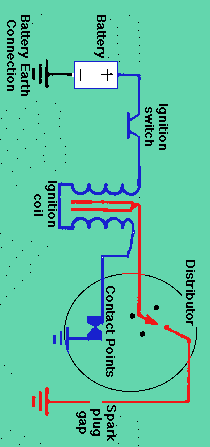
 Back
to top
Back
to top