
 |
Series Land Rover
(Australia
& NZ)
|
 |
  |
|
 or
or 
 sections
 Removing and Checking a Series Land Rover Thermostat
 Enter EnterLand Rover Series 3 Problem you can't solve? Check the Tech Articles  Series
quiz Series
quizTry Series 1 quiz only Try Series 2 quiz only Try Series 3 quiz only 4x4 offroad quiz Choose how many multiple choice questions you attempt. Rank your score with other participants.
Last Updated 17/11/08 |
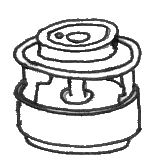
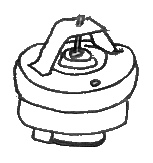
A Series Land Rover is not normally associated with serious overheating problems as it was designed to operate agricultural machinery for lengthy periods whilst stationary. The Series radiator does not normally require additional help to dissipate heat. Nevertheless, a possible cause of serious overheating is the thermostat becoming jammed closed thus restricting movement of coolant around the engine block. If the coolant has problems reaching the radiator then the engine will overheat. The engine bay in a Series Land Rover has good access and the thermostat is removable in a few minutes. First, the radiator must be at least partially drained (half will do). Then, the top radiator hose should be disconnected and the 3 bolts holding the thermostat housing in position removed. Once removed, the thermostat can be lifted out and its operation checked by heating it in a container of water. The therrmostat should be fully open before the water boils. If a thermometer is available then it should begin to open at about 72C and be fully open by 85C. If a fault is discovered in the thermostat then a replacement is needed as they cannot be repaired. There are two types of thermostat fitted to Series Land Rovers engines; they are illustrated above. If a replacement thermostat is required then the replacement should be of the same type as the riginal because interchanging them can block off part of the coolant channel in the wrong thermostat housing. |


Hitch a Series ride
 Back
to top
Back
to top